
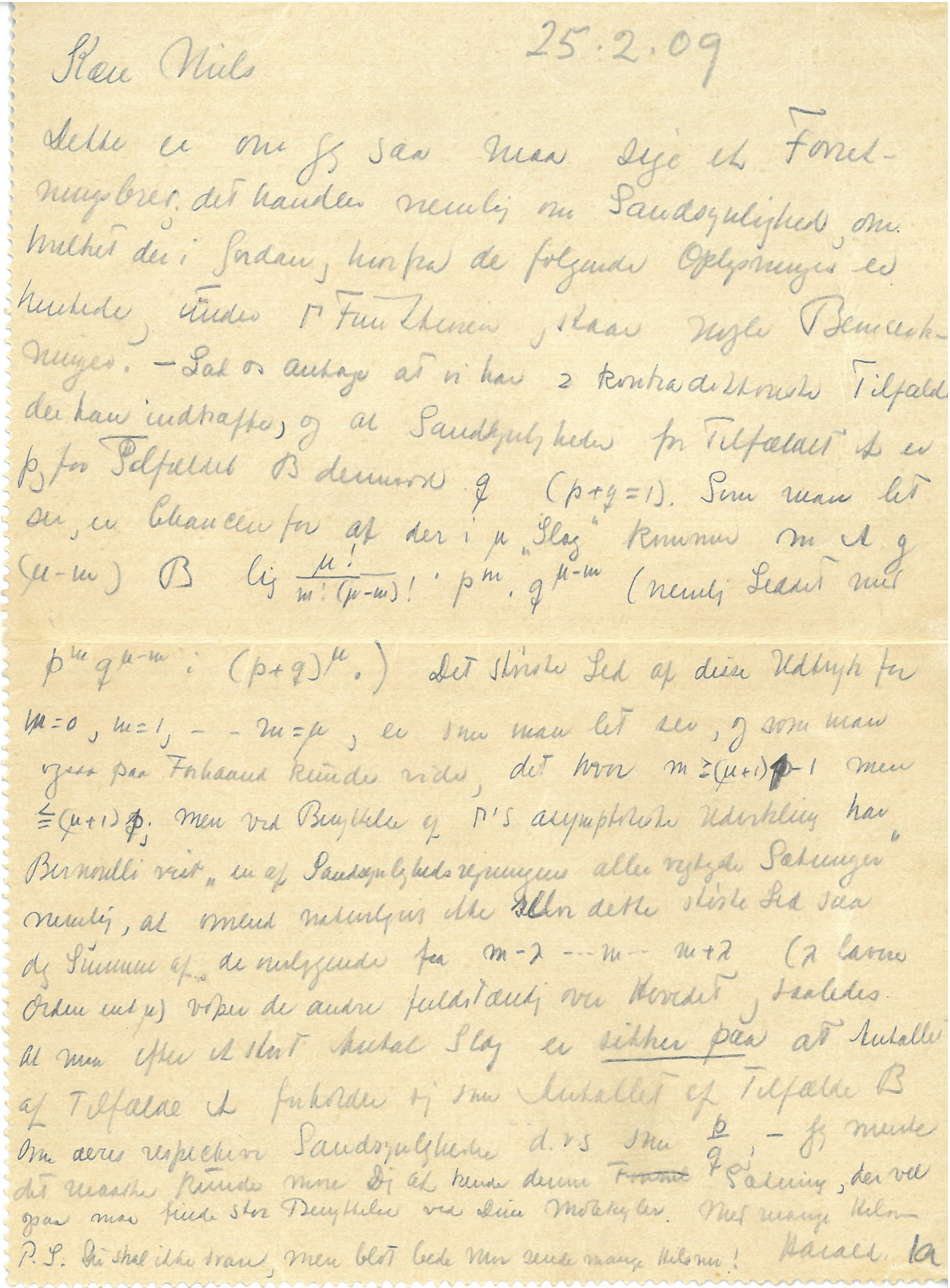
This is, if I may say so, a business letter; for it concerns probability, where Jordan, from where I have obtained the following information, has some comments under the \(\Gamma\) Let us assume that we have 2 contradictory instances which can occur, and that the probability for instance \(A\) is \(p\), for instance \(B\) on the other hand \(q\;(p+q=1)\). As one easily sees, the chance that, in \(\mu\) “throws”, one gets \(m\) \(A\) and \((\mu-m) \; B\:\) is \(\frac{\mu!}{m!(\mu-m)!} \cdot p^m \cdot q^{\mu-m}\) (namely the term with \({p^m}{q^{\mu-m}}\) in \({(p+q)}^{\mu}\).) The largest term of these expressions for \(m=0\), \(m=1\), ..., \(m=\mu\), is, as one easily sees, and which one also could have known already, is the one for which \(m\geq(\mu+1)p-1\), and \(\leq(\mu+1)p\); but by application of \(\Gamma\)’s asymptotic expansion, Bernoulli has shown “one of the most important theorems of the theory of probability” namely, that while naturally not the largest term itself, nevertheless the sum of those close by, from \(m- \lambda\) ... \(m\) ... \(m+\lambda\) (\(\lambda\:\) of lesser order than \(\mu\)) completely dominates the other terms, so that after a large number of throws, one is sure that the number of instances \(A\) relates to the number of instances \(B\) as their respective probabilities, i.e. as \(\frac{p}{q}\); – I thought it might amuse you to know this theorem, which I presume must find application in your molecules.
P.S. You must not reply, just ask Ma to send many greetings! |