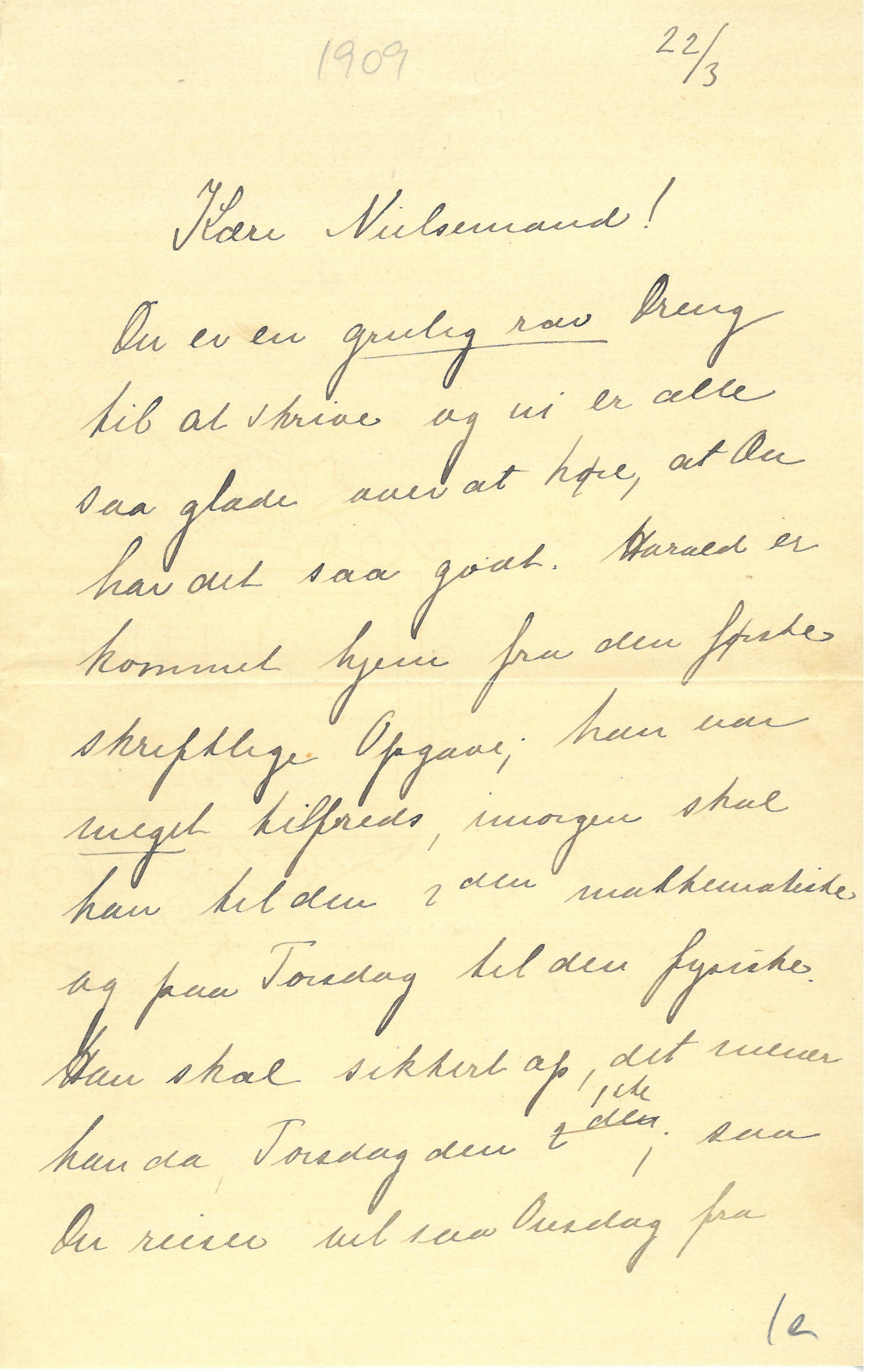
You are an awfully nice boy when it comes to writing and we are all so pleased to hear that you are so well. Harald has come home after the first written assignment and was very satisfied, tomorrow he will attend the 2nd mathematics and on Thursday physics. He believes that he will be examined on Thursday the 1st, so you will be also travelling from Funen on Wednesday and will be here Wednesday evening or so say Dad and Harald.
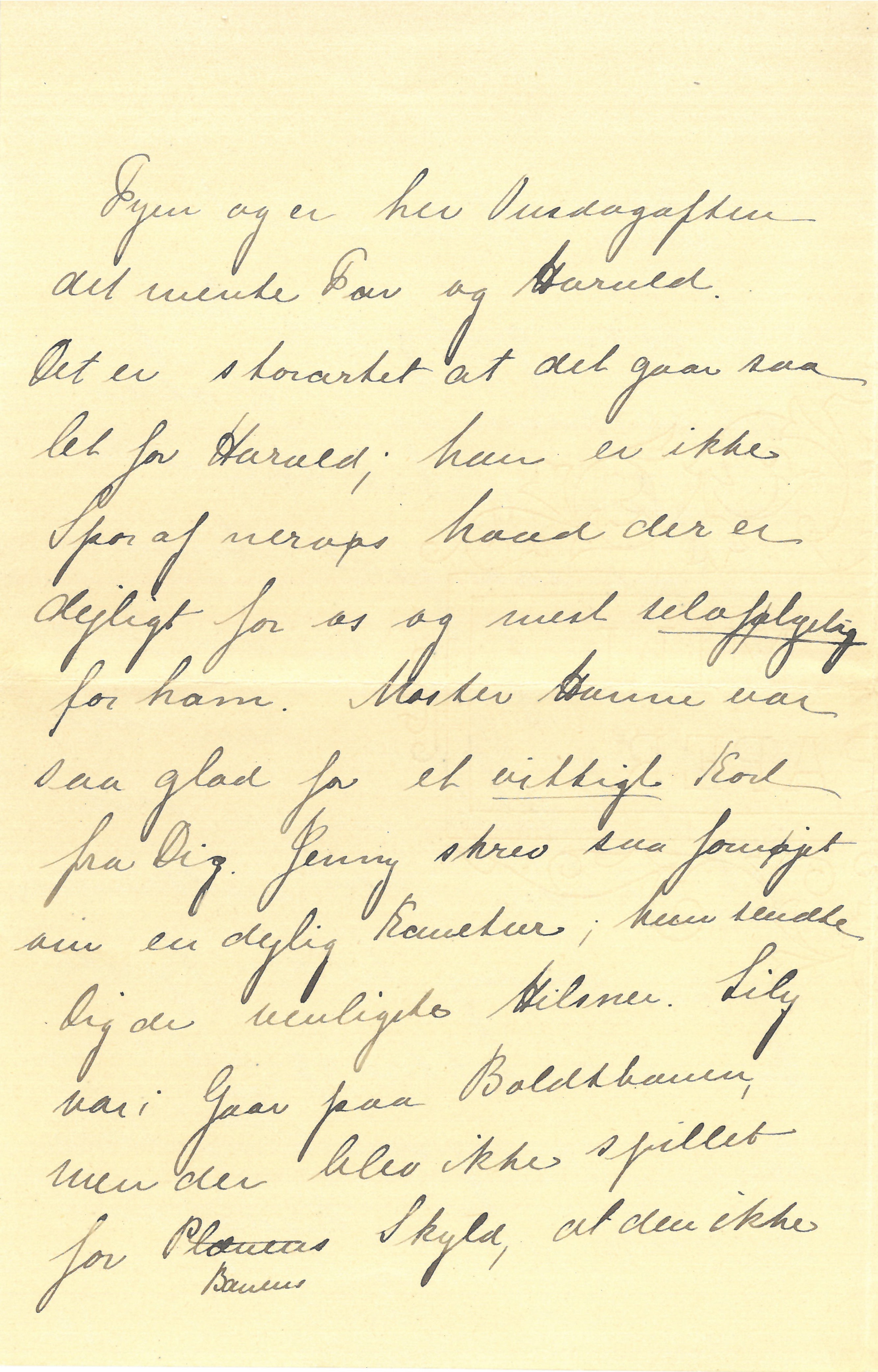
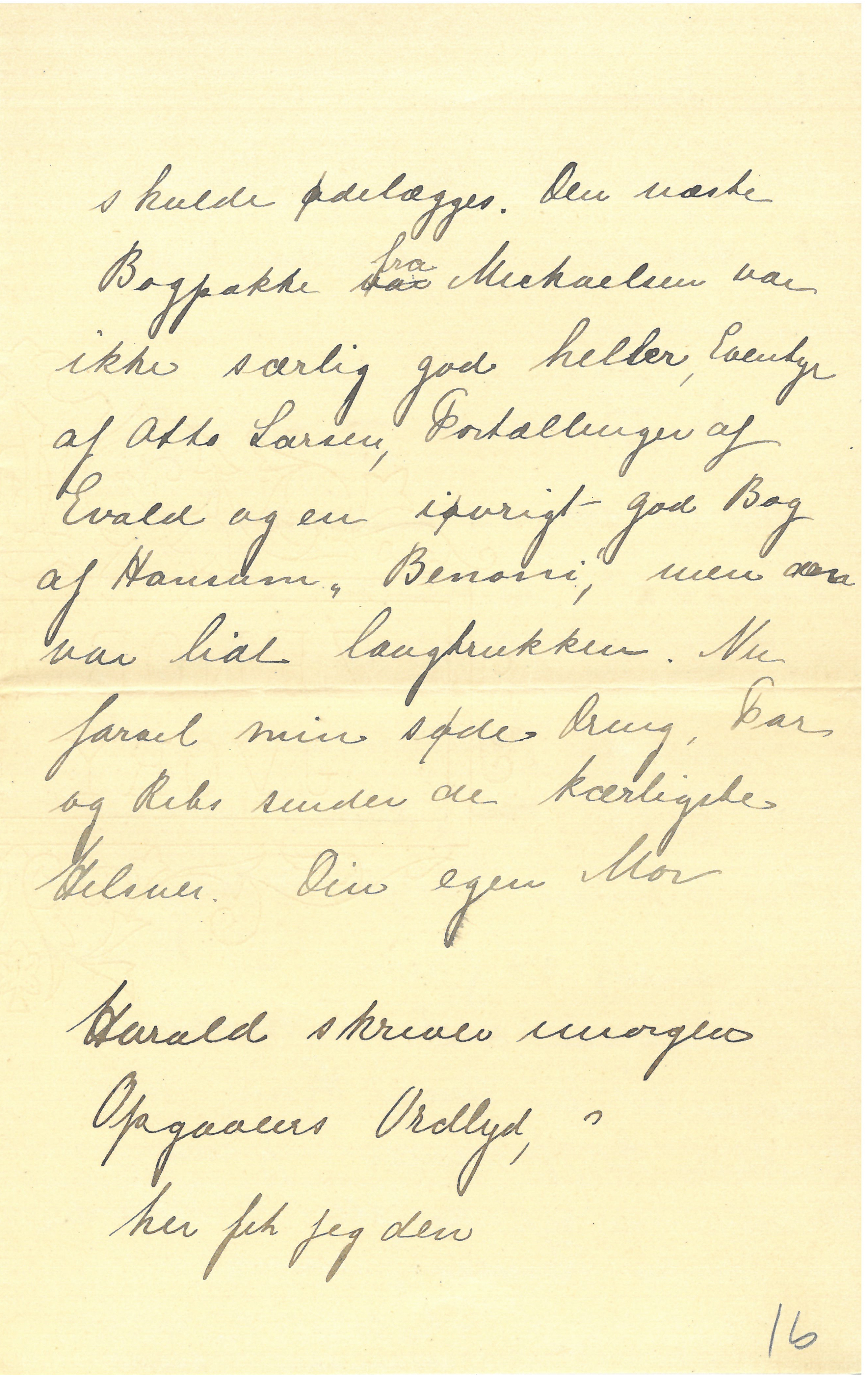
It is wonderful that it is so easy for Harald; he isn’t nervous at all which is lovely for us and of course for himself. Aunt Hanne was so pleased with the witty card from you. Jenny wrote so delighted about a lovely sleigh ride; she sent all her best regards to you. Lily was down at the football pitch yesterday, but no one was playing for the sake of the pitch so as it shouldn’t be spoiled. The next book package from Michaelsen wasn’t very good either, fairy tales by Otto Larsen, stories by Evald and an otherwise good book by Hamsun “Benoni”, but which was rather long winded. Now goodbye my sweet boy, Pa and Ribs send their love.
Harald will write tomorrow with the assignment,
Here I got it
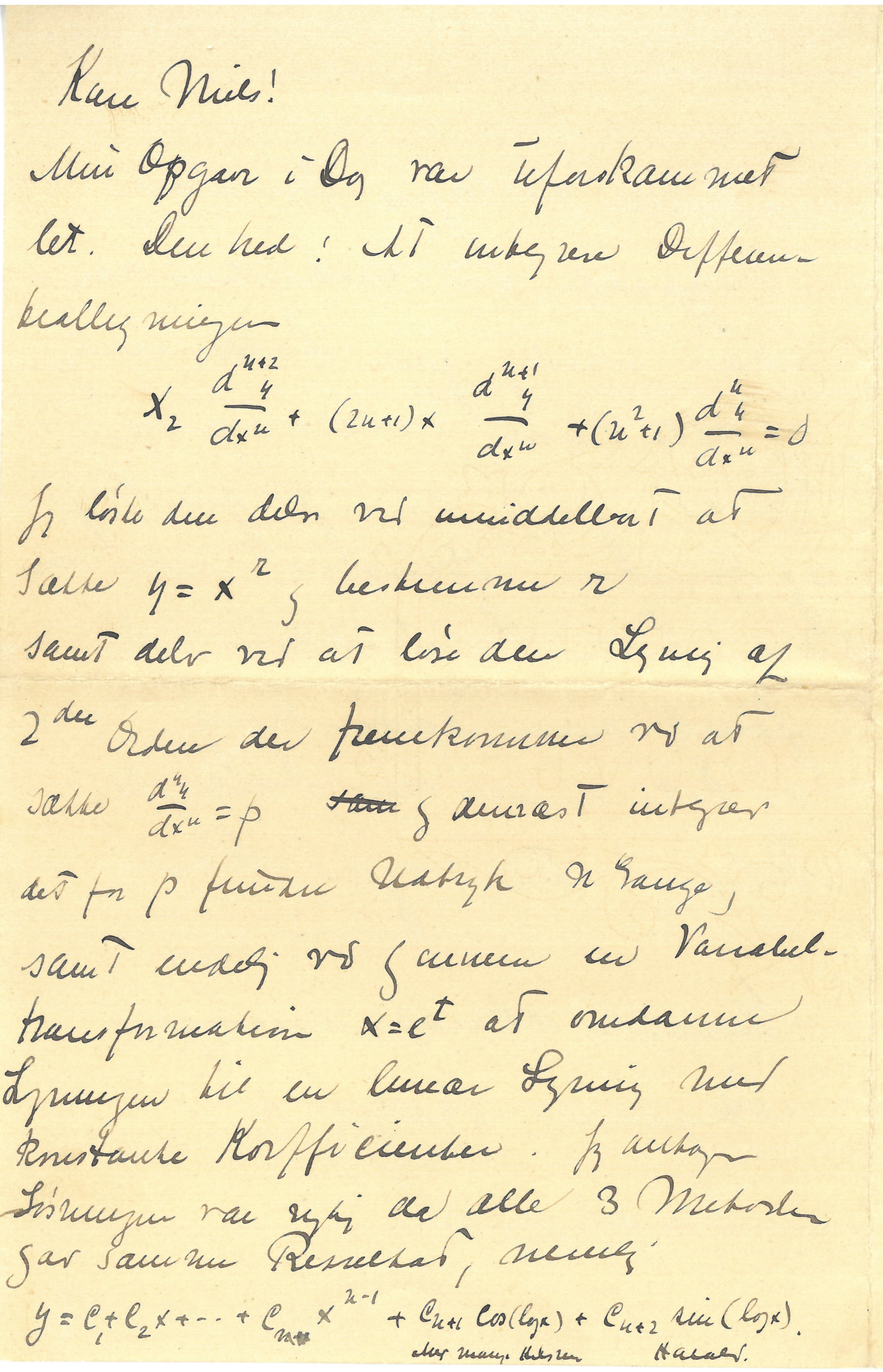
My question today was so embarrassingly simple. It went: To integrate the
differential equation
$$x^2\frac{d^{n+2}y}{{dx}^{n}}+(2n+1)x\frac{d^{n+1}y}{dx^{n}}+(n^2+1)\frac{d^{n}y}{dx^n}=0$$
I solved it in part by immediately setting \(y=x^r\) and determining \(r\), and
in part by solving the 2den degree equation arising by setting
\(\frac{d^{n}y}{{dx}^{n}} = p\) and then
integrating the expression for \(p\)
\(n\) times, and finally through a transformation
of variables \(x=e^t\) thus transforming the
equation to a linear equation with constant coefficients. I assume the solution was
correct since all 3 methods gave the same result, namely
\(y=c_1+c_2x+\cdots+c_nx^{n-1}+c_{n+1}\cos(\log x)+c_{n+2}\sin(\log x)\)