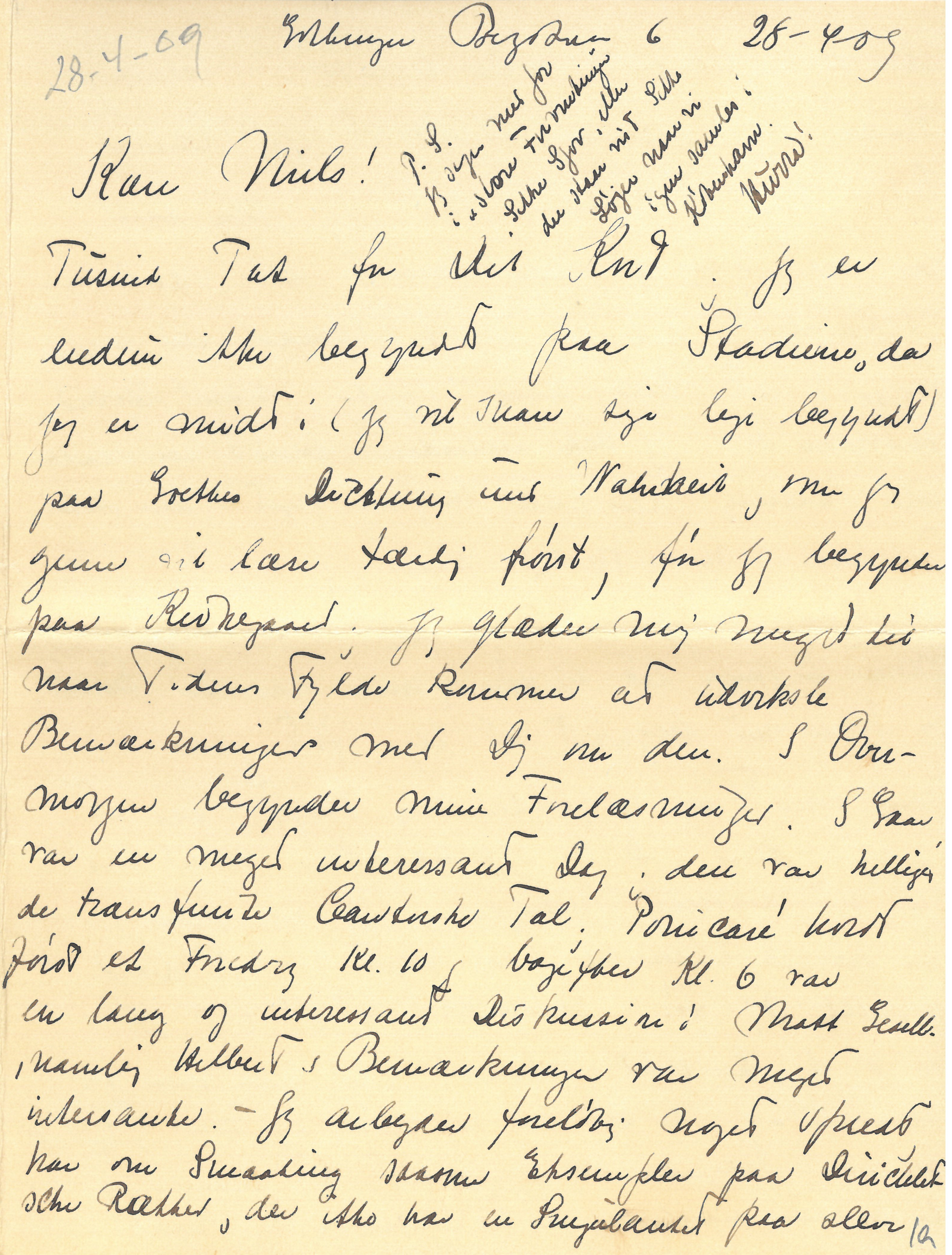
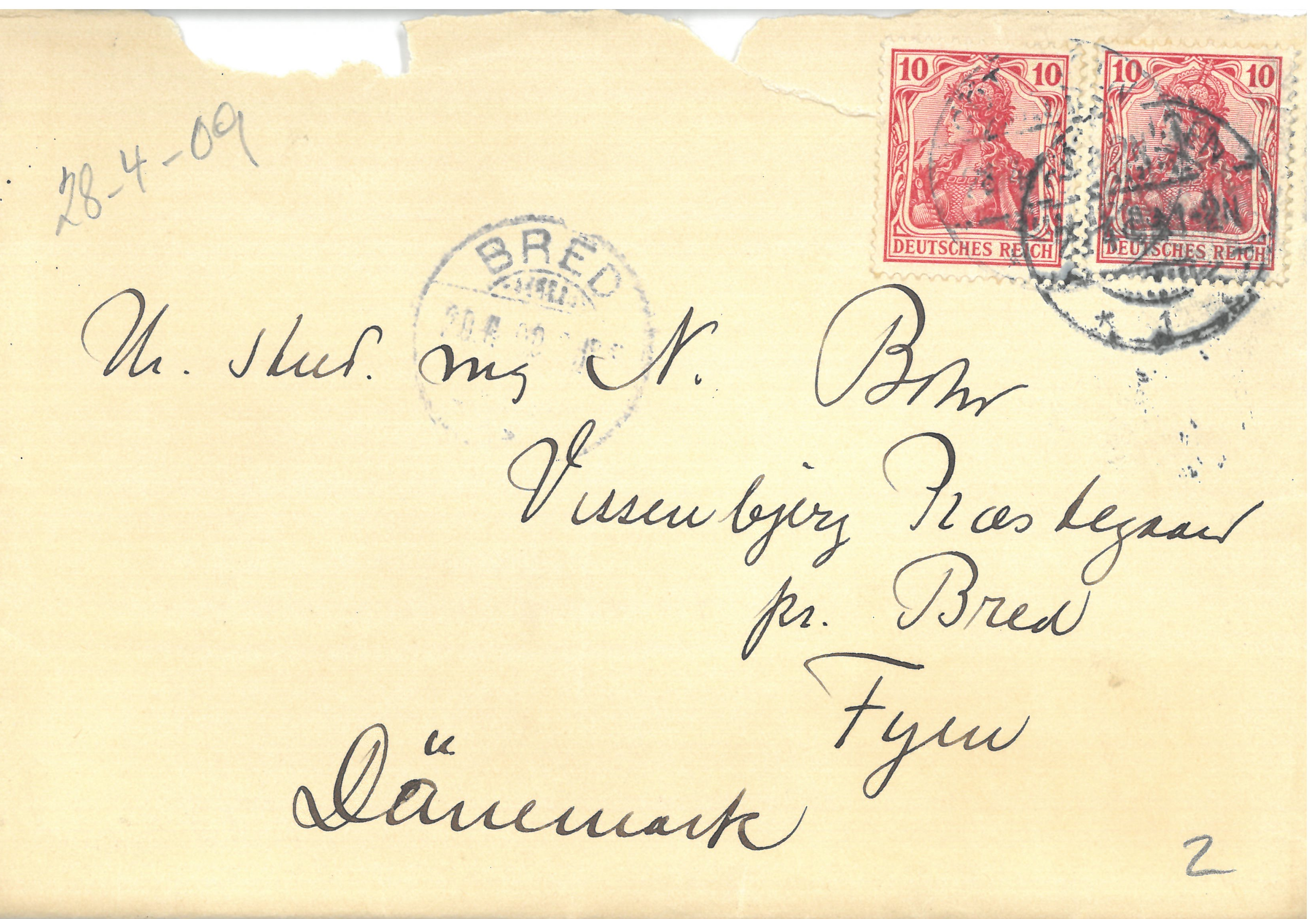
A thousand thanks for your card; I have still not begun Stages, as I am in the middle
of
(I am ashamed to say just begun) Goethe’s Dichtung und Wahrheit, which I want to finish
before reading Kierkegaard; I am looking forward, in the fullness of time, to exchanging
commentary about it with you. My lectures begin the day after tomorrow. Yesterday
was an
interesting day; which I dedicated to the transfinite Cantor numbers; Poincaré gave a lecture at 10 o’clock and
afterwards, at 6 o’clock there was a long, interesting discussion at the Math. Gesell..,
Hilbert's comments were particularly
interesting. – I am working until now in a rather diffuse fashion, with small matters
such as examples of Dirichlet series, with no singularity on the |convergence line itself but rather in “beliebiger
Nahe” and the like, I have exchanged a series of letters with Landau, I, as he has requested of me, have formed
all such examples; at any rate it is a useful exercise in writing German one achieves
by
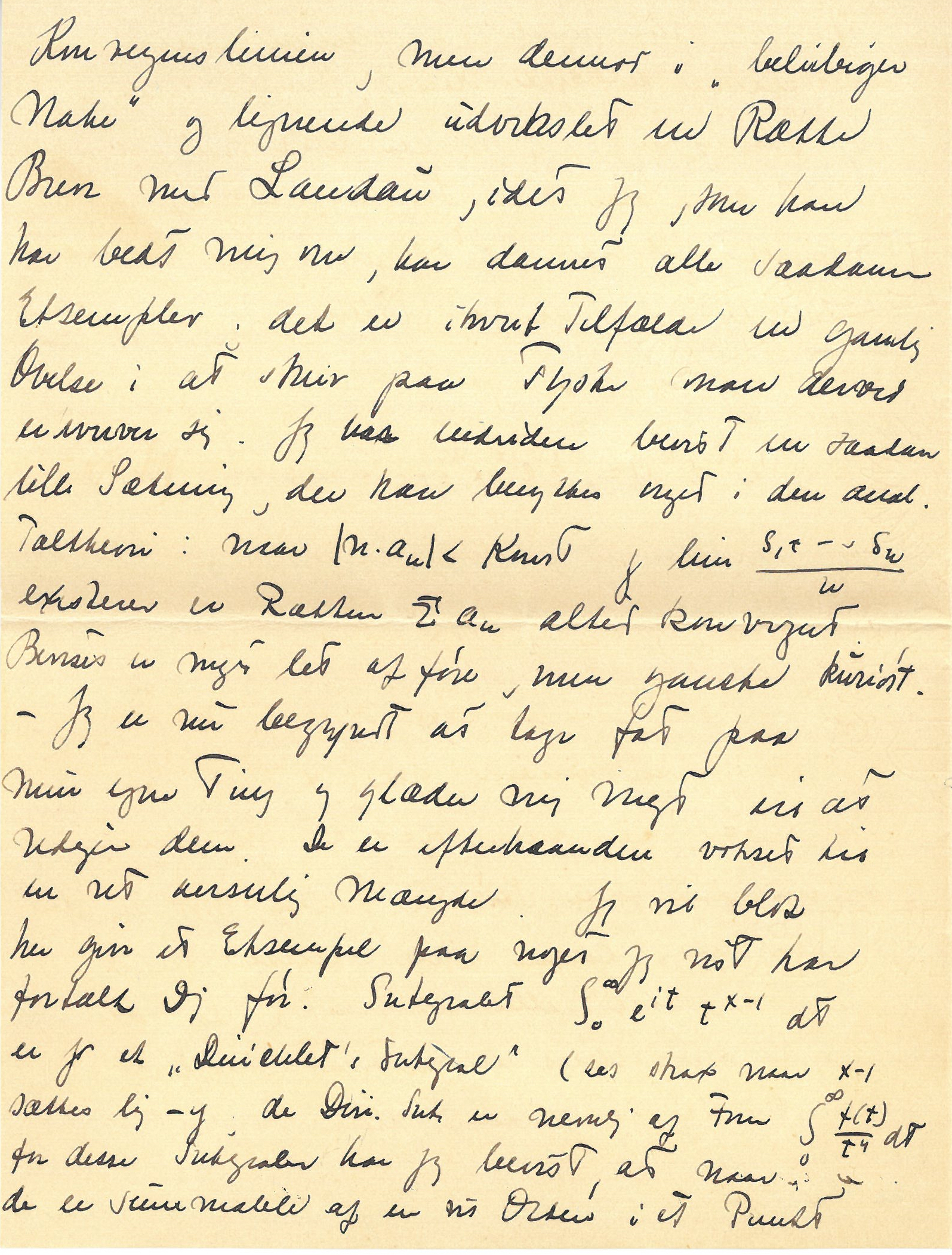
this. Furthermore, I have also proven a little theorem that can be used a lot in anal.
number theory: when \(|n\cdot a_n|\:\) < Const.
and \(\lim \frac{S_1 + \cdots + S_n}{n}\) exists , the
series \(\sum a_n\) is always convergent. The proof is
easy to use but very curious. – I am now beginning to take charge of my own things
and
am looking forward to publishing them. They have by now grown to quite a considerable
amount. Here, I’d like to give one example of something I think I have told you before.
The integral \(\int_0^\infty e^{it}t^{x-1}dt\) is, as
you know, a “Dirichlet integral” (obvious when \(x-1\)
is set equal to \(-y\); since the Diri. Int. have the
form \(\int_0^\infty \frac{f(t)}{t^y}dt\); for these
integrals I have proved that when they are summable of a given order at a point, |then they are always summable of the given
order in the half-plane to the right thereof (in analogy with the theorem of the node).
Here I will simply show how easily one can show summabili. of the mentioned integral
\(\int_0^\infty e^{it} t^{x-1} dt\) in the whole
half-plane to the left (since we have \(t^x\) “in the
numerator” and not “in the denominator”)
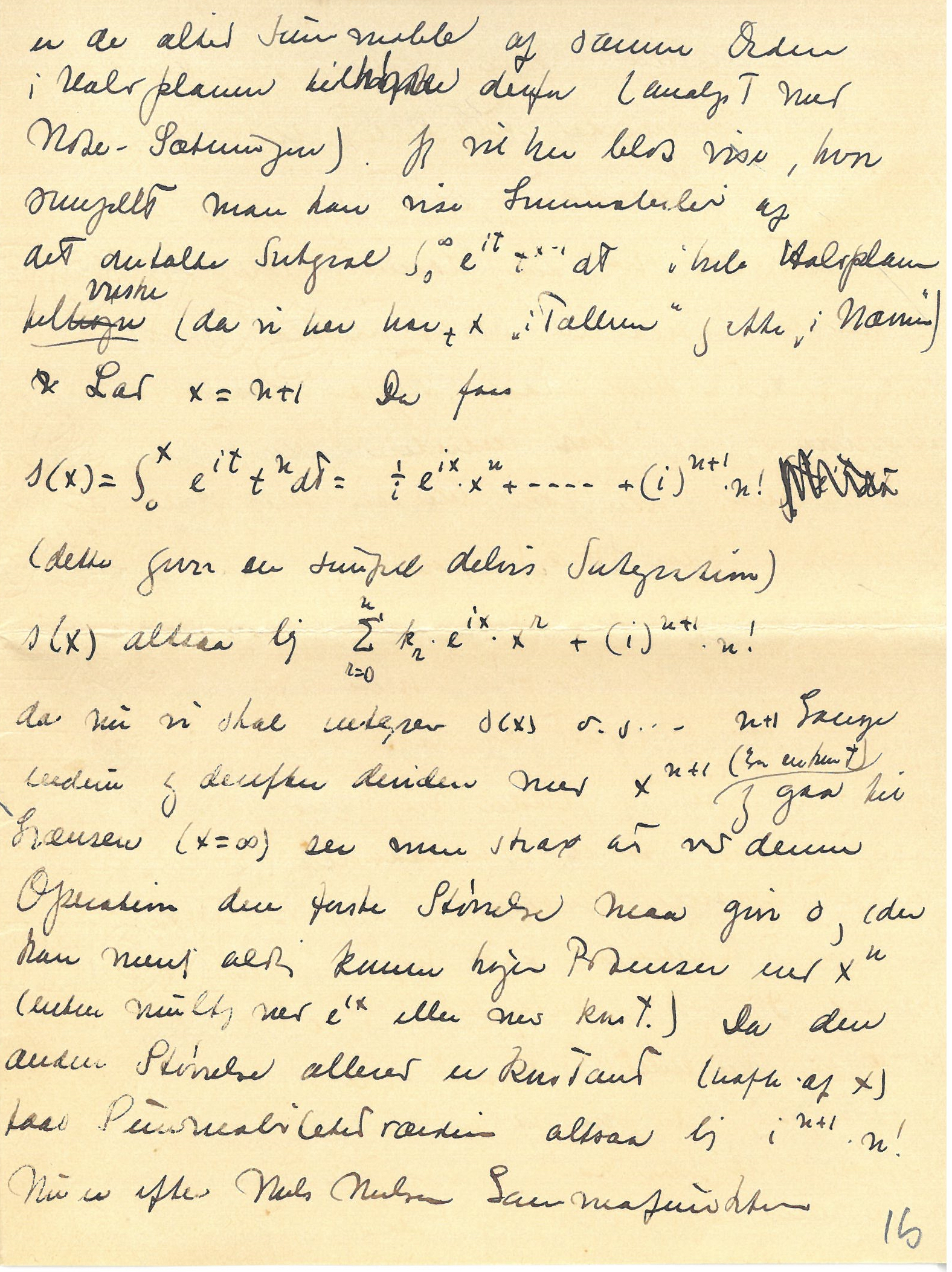
Let \(x=n+1\) Then we have
$$s(x) = \int^x_0e^{it} \, {t^n dt} = \frac{1}{i}e^{ix} \cdot
x^{n} +\cdots + (i)^{n + 1} \cdot n!$$
(this is what a simple partial integration yields)
$$s(x) \quad\text{is then equal to}\quad \sum_{r=0}^n k_r \cdot
e^{ix} \cdot x^r + (i)^{n + 1} \cdot n!$$
since we now must integrate \(s(x)\) etc. ...
\(n+1\) times and thereafter divide through by
\(x^{n+1}\) (with \(n\) unkown) and take the limit (\(x=\infty\)) we see immediately that by this operation the first term
must be \(0\), (namely since we can never get a power
higher than \(x^n\) (either mult. by \(e^{ix}\) or by a const.) Since the other term is already
constant (indep. of \(x\)) we get the value of
summation equal to \(i^{n+1}\cdot n!\:\) Now following
Niels Nielsen the gammafunction |
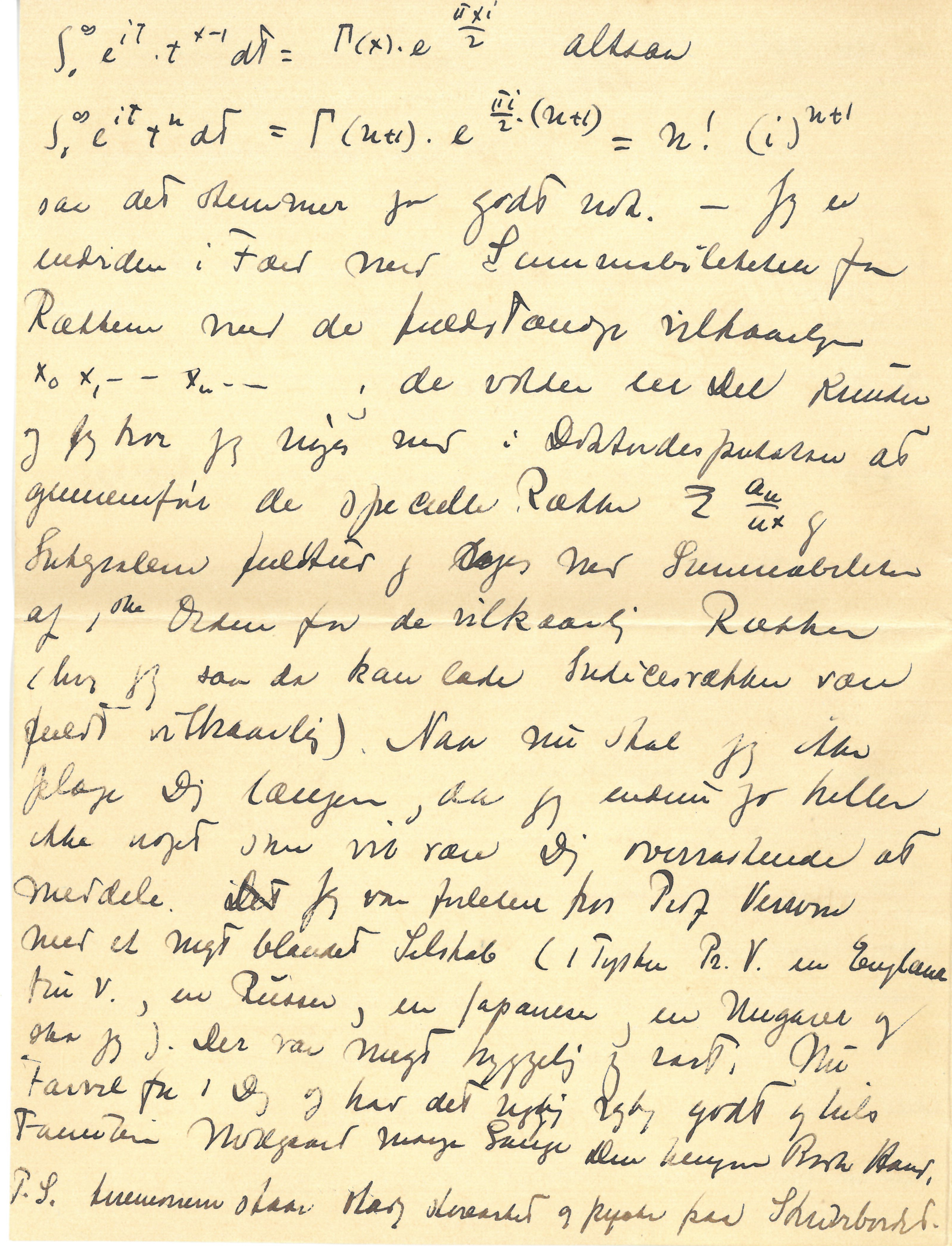
$$\int^{\infty}_{0} e^{it} \cdot t^{x-1} dt = \Gamma(x) \cdot
e^{\frac{\pi xi}{2}} \quad \text{thus} $$
$$\int^{\infty}_0 \, e^{it} \, t^n \, dt = \Gamma (n + 1) \cdot
e^{\frac{\pi i}{2} \cdot (n + 1)} = n! \, (i)^{n + 1}$$
So that all fits reasonably well. – I am furthermore engaging with the summability
for series with completely arbitrary \(x_0 \; x_1 \cdots x_n
\cdots\); they involve quite some puzzles and I think, in the Doctoral
thesis, I will do the special series \(\sum
\frac{a_{n}}{n^x}\) and the Integrals completely, and then settle for
summability of 1storder for arbitrary series (where I can then let
the series of indices be completely arbitrary). Now I will not bother you any more,
as I
have not yet anything to tell which will be surprising for you. The other day I was
at
Prof Verworn with a very mixed company (1
German Pr. V. one from England mrs. V., one Russian, one Japanese, one Hungarian and
myself). It was cozy and nice. Now goodbye for today and have a very very nice time
and
many greetings to the Møllgaard family
P.S. The anemones are still doing well and decorating my desk.