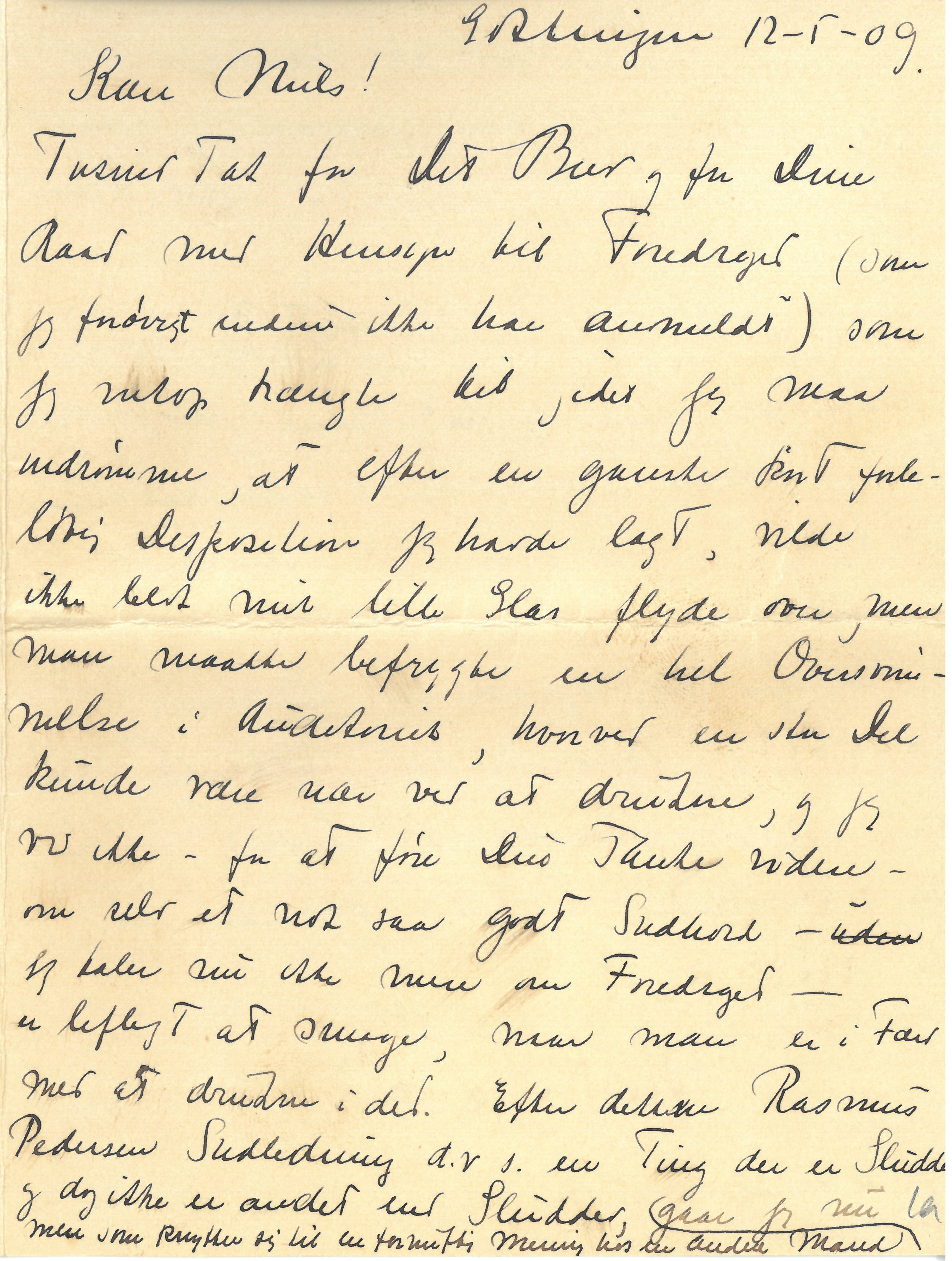

Many thanks for your letter and your advice concerning the lecture (which, by the
way I
have still not announced) which I stood in need of as, I admit, that after a short
preliminary plan I made, not only would my little cup overflow, but there would be
a
risk of my flooding the whole auditorium and drowning a large number and I do not
know –
to extend this train of thought – whether even such an excellent content – I am no
longer referring to the lecture – would be sweet to taste when one is drowning in
it.
After that Rasmus Pedersen introduction
i.e. something that is nonsense and nothing but nonsense but which is associated with
reasonable opinion of another man, |I would
like to briefly relate an equation I have discovered which, if I may say so, fits
my
bill. Namely:
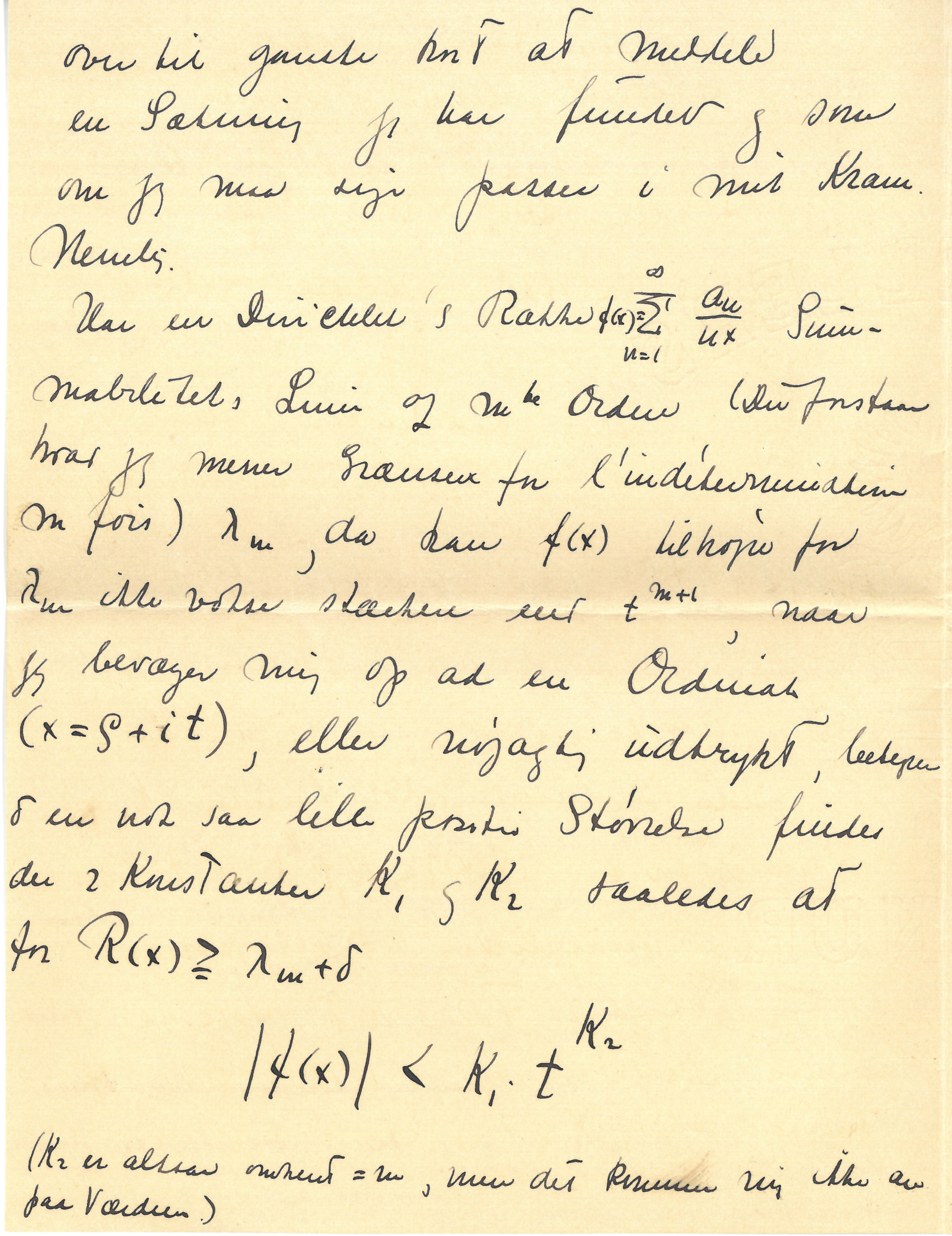
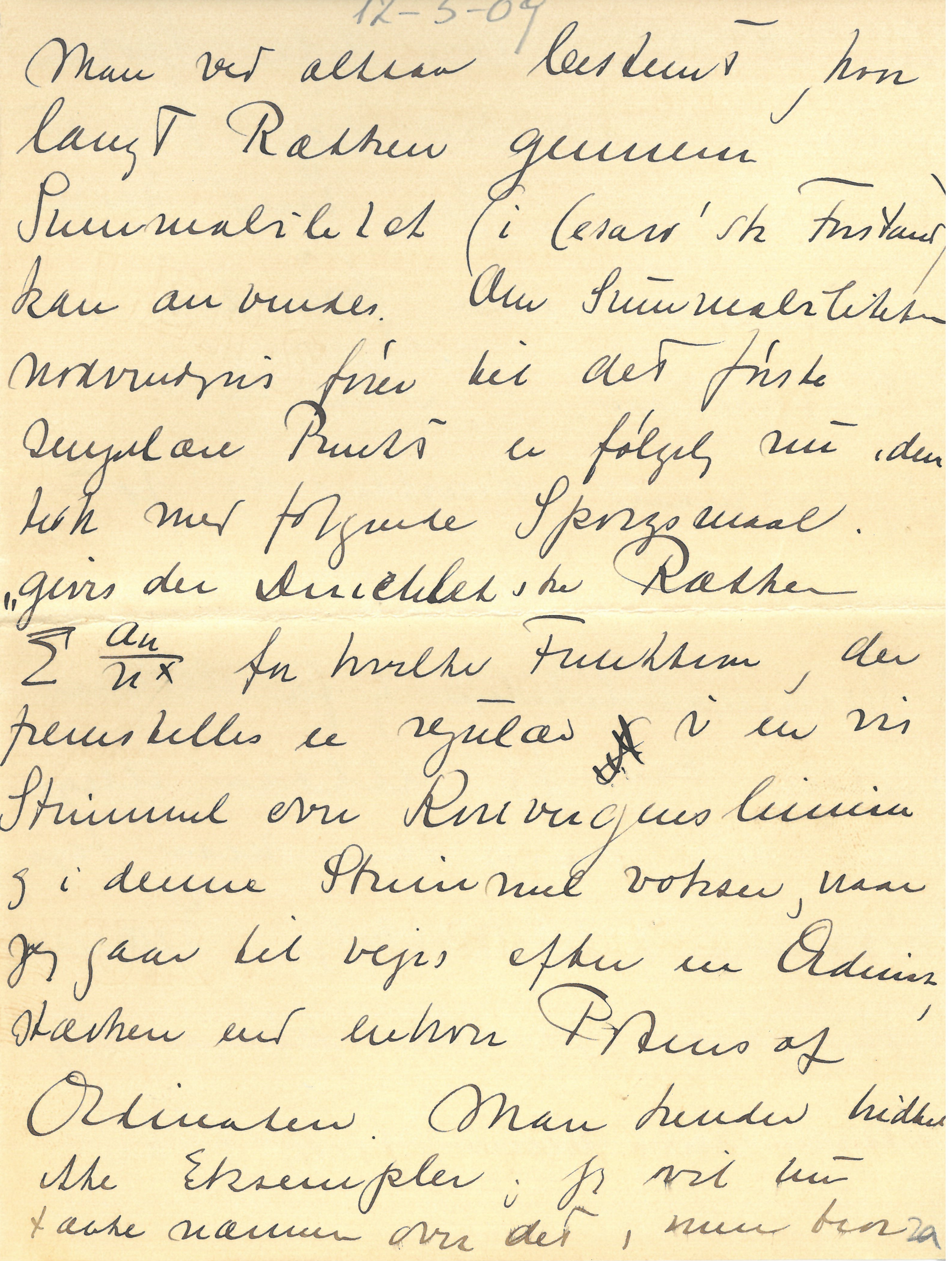
If a Dirichlet series
\(f(x)=\sum_{n=1}^{\infty} \frac{a_{n}}{n^x}\) has
summability line of \(m^\text{th}\) order (you
understand what I mean, the limit for l’indétermination \(m\) fois) \(\lambda_m\), then \(f(x)\) to the right of \(\lambda_m\) cannot grow faster than \(t^{m+1}\), when I move up the ordinate \((x=\varsigma+it)\), or more precisely, if \(\delta\) is a small enough positive magnitude there exist 2 constants
\(K_1\) and \(K_2\) so that for \(R(x)\geq \lambda_m +
\delta\) $$|f(x)| <K_1\cdot t^{K_2}$$
(\(K_2\) is thus conversely \(=m\), but apparently it does not depend on the value.)
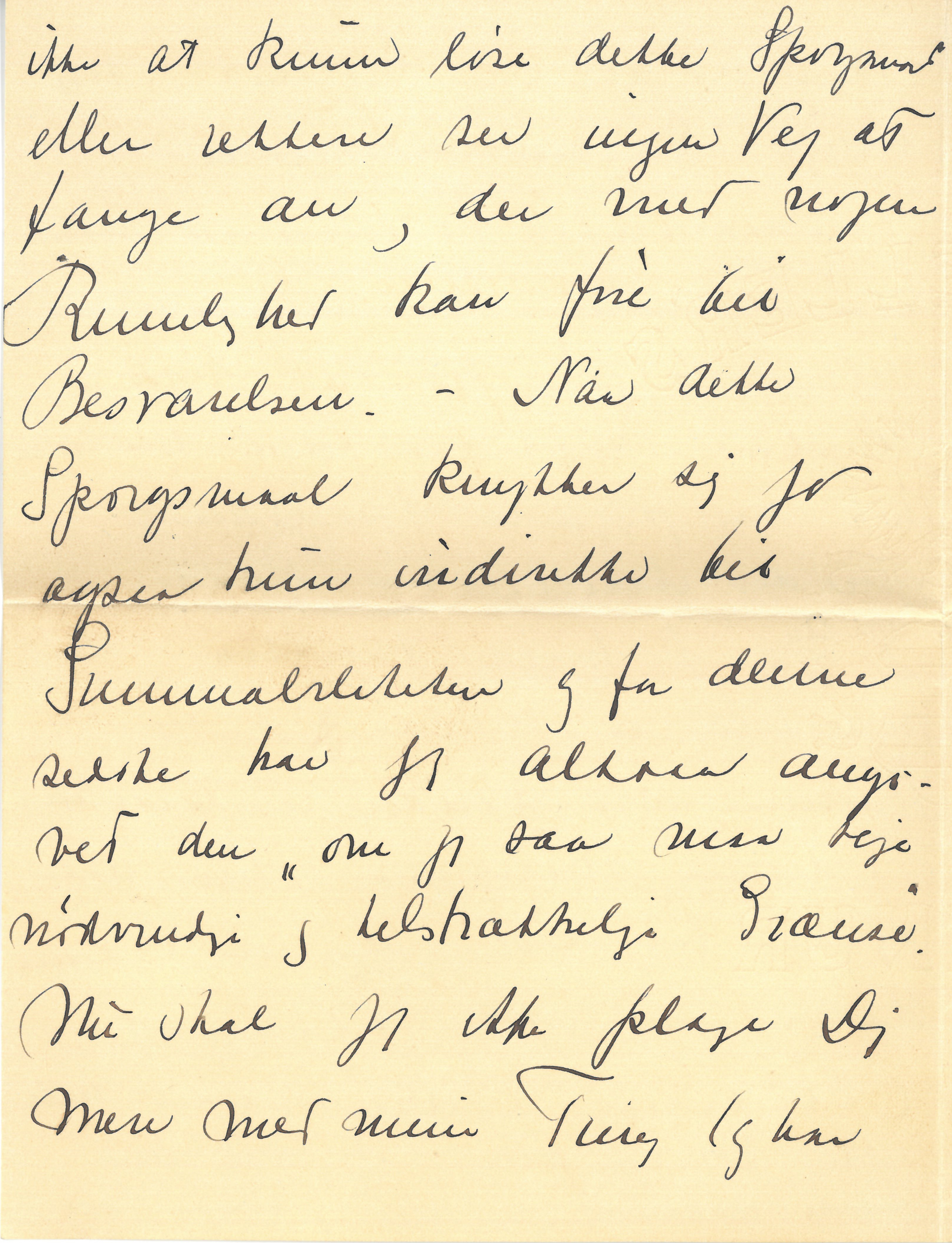
|I can see that I have got the introduction
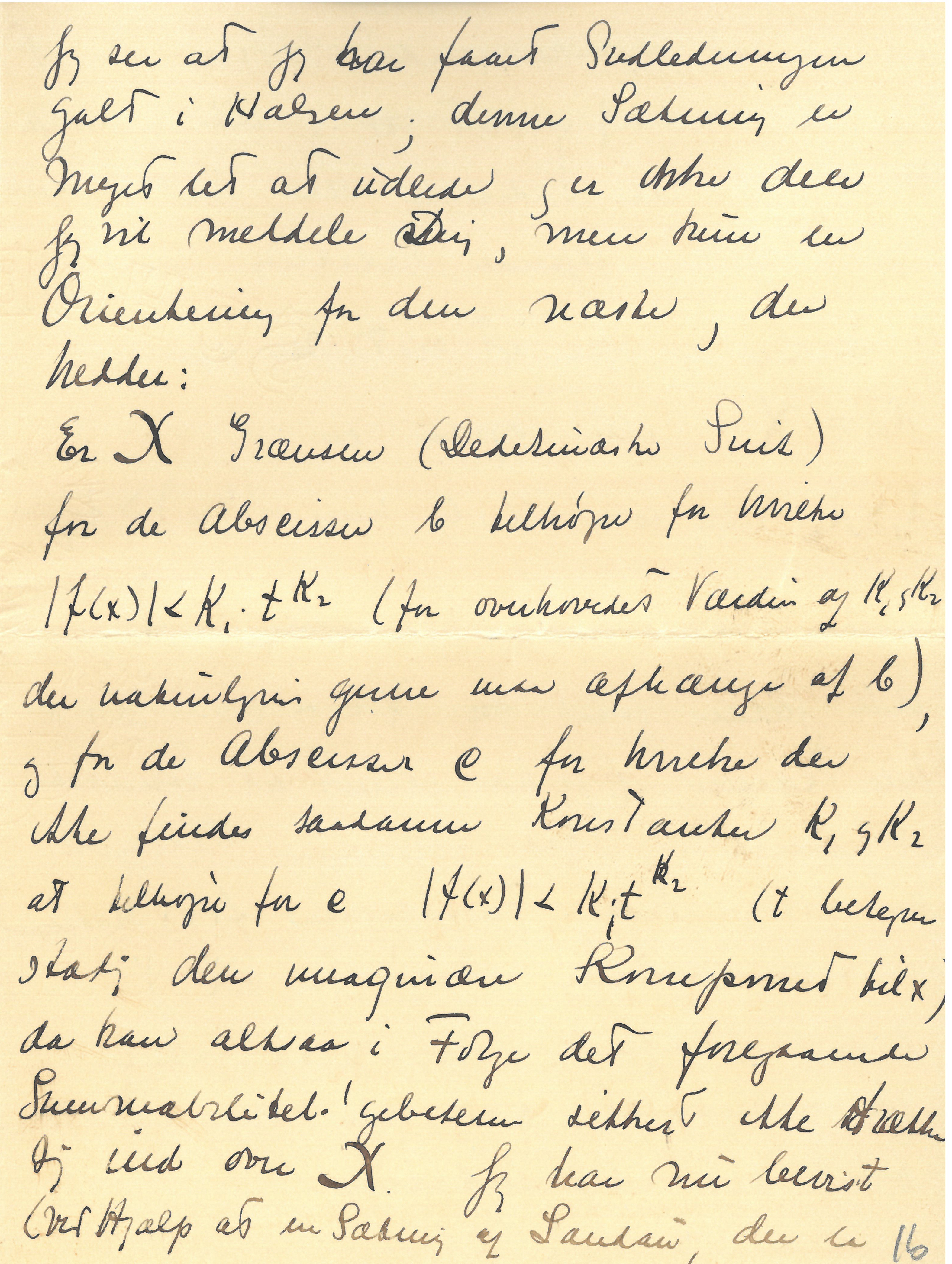
wrong; this proposition is easy to deduce and not the one I want to relate to you,
only
a directive for the next which goes:
If \(X\) is
the limit (Dedekind cut) for the abscissae \(b\) to
the right of which \(|f(x)| < K_1\cdot t^{K_2}\)
(where the value of \(K_1\) and \(K_2\) naturally may depend on \(b\)), and for those abscissae \(c\)
for which there do not exist such constants \(K_1\)
and \(K_2\) that to the right of \(c\) \(\quad\) \(|f(x)| < K_1\cdot t^{K_2}\) (\(t\) still denotes the imaginary component of \(x\)) then according to the previous summabilit. ‘gebeteten
certainly cannot exceed past \(X\). I have now proved
(with the aid of a theorem of Landau,
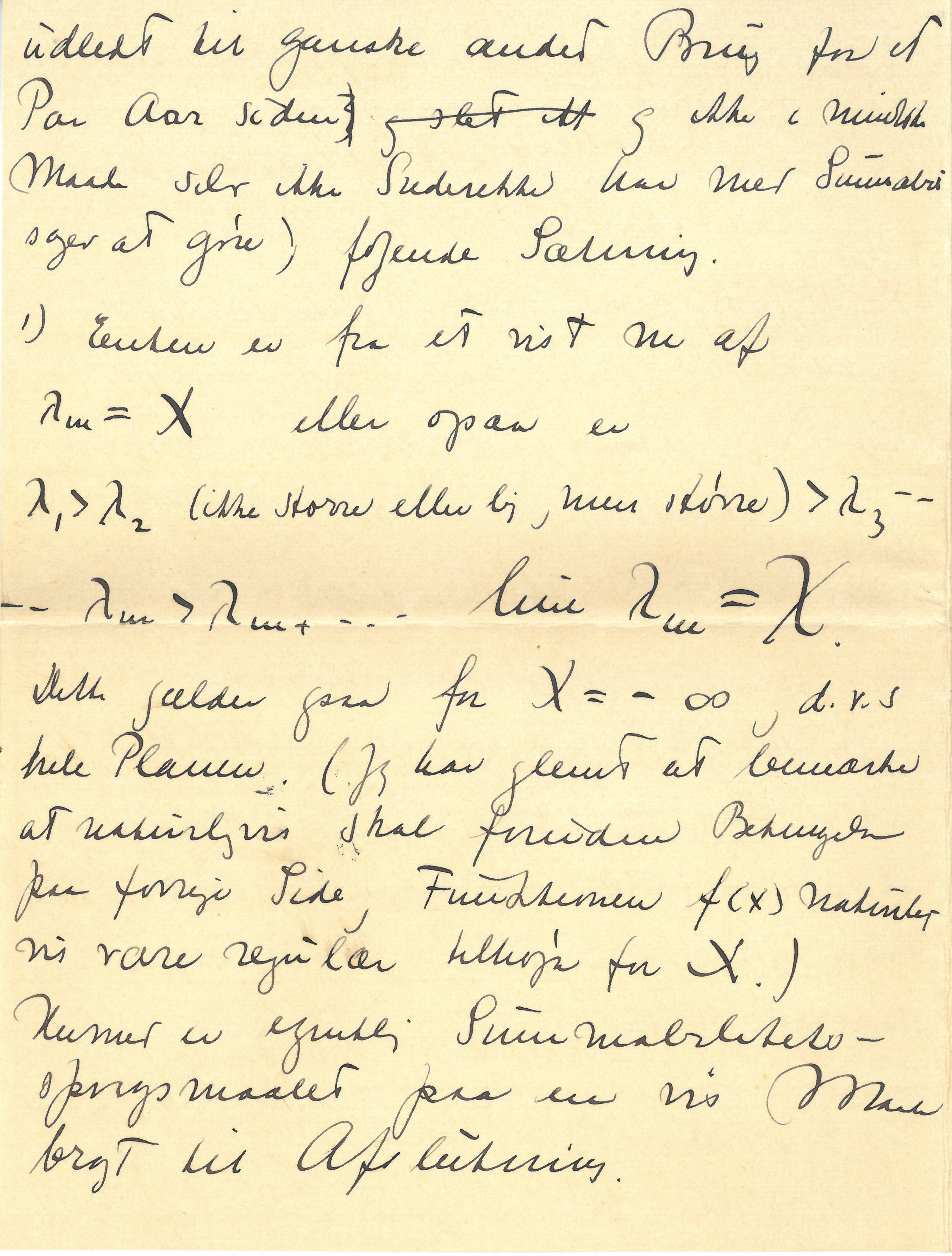
deduced a few years ago for a completely different purpose, and not even indirectly
related to summabi.) the following theorem.
1) Either there is a certain \(m\) after which \(\lambda_m =
X\) or else
\(\lambda_1 > \lambda_2\) (not greater than or
equal, but greater) \(> \lambda_3 \cdots \)
\(\lambda_m > \lambda_{m+}\cdots\) line \(\lambda_m=X\).
This also holds for \(X=-\infty\), i.e. the whole plane. (I have forgotten to
remark that of course in addition to the conditions stated on the preceding page,
the
function \(f(x)\) must of course be regular to the
right of \(X\).)
In this way the summability question is, in a certain sense, brought to a conclusion.
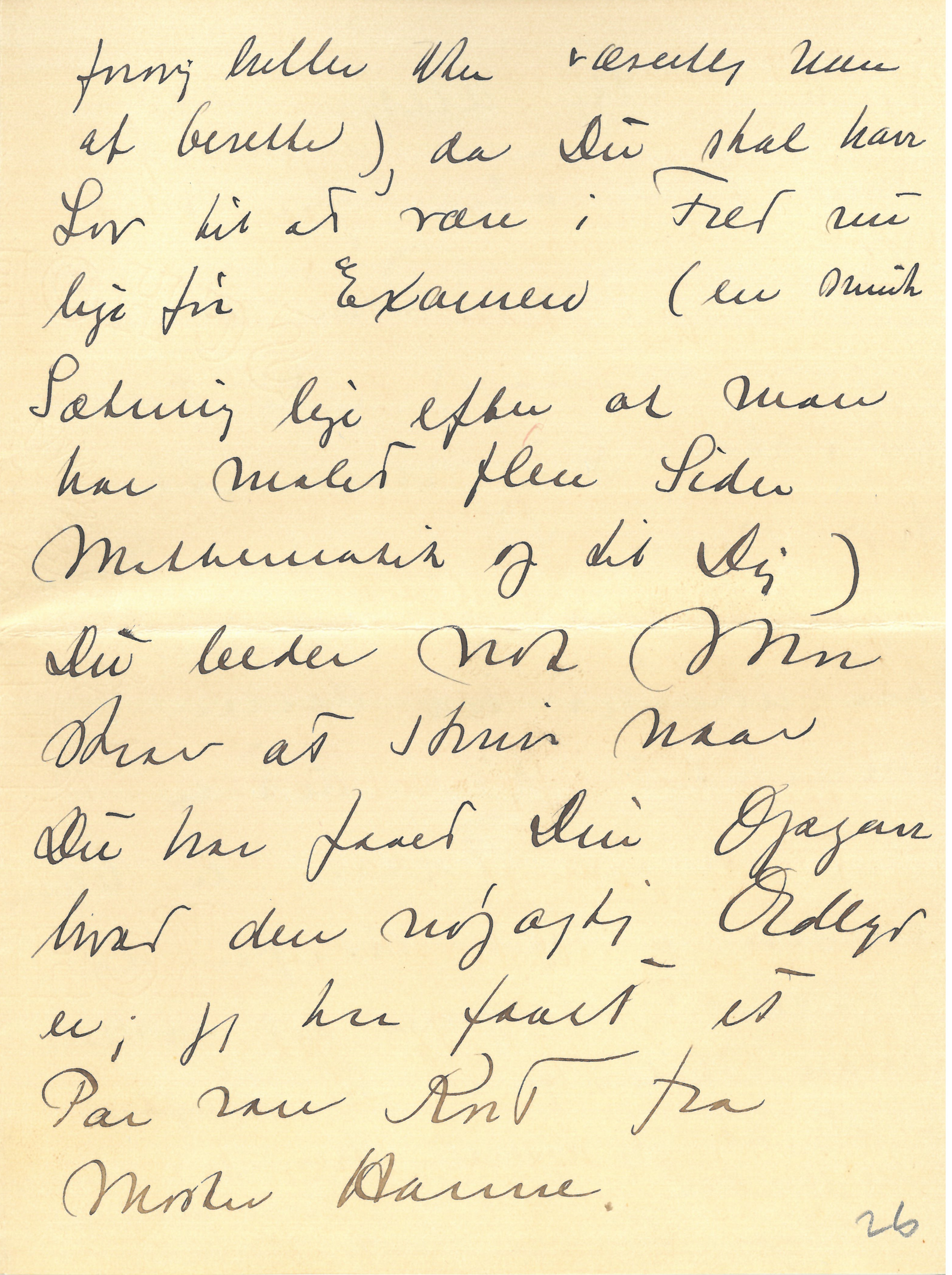
|Thus one knows exactly how far the series can be extended through summability (in Cesaro’s sense). Whether summability necessarily leads to the first singularity is now equivalent with the following questions “is there a Dirichlet series \(\sum \frac{a_{n}}{n^{x}}\) for which the function represented is regular in a strip past the convergence line, and which in this strip grows, when I increase following an ordinate faster than any power of the ordinate. One does not yet know any examples; I will now think more closely about this, one does not think |it possible to solve this question, or rather see any path to commence on, that might reasonably lead to the answer. – Well this question is only indirectly related to summability, and for the latter I have now given the “if I may say so, necessary and sufficient limit”. Now I won’t bother you any more with my things (and I |really do not have much more to relate) as you should be left in peace now just before the exam (a fine sentence after one has just filled several pages with mathematics for you.) You will ask Ma to write as soon as you have received your assignment, what the exact wording is; I have had a couple of nice cards from Aunt Hanne.
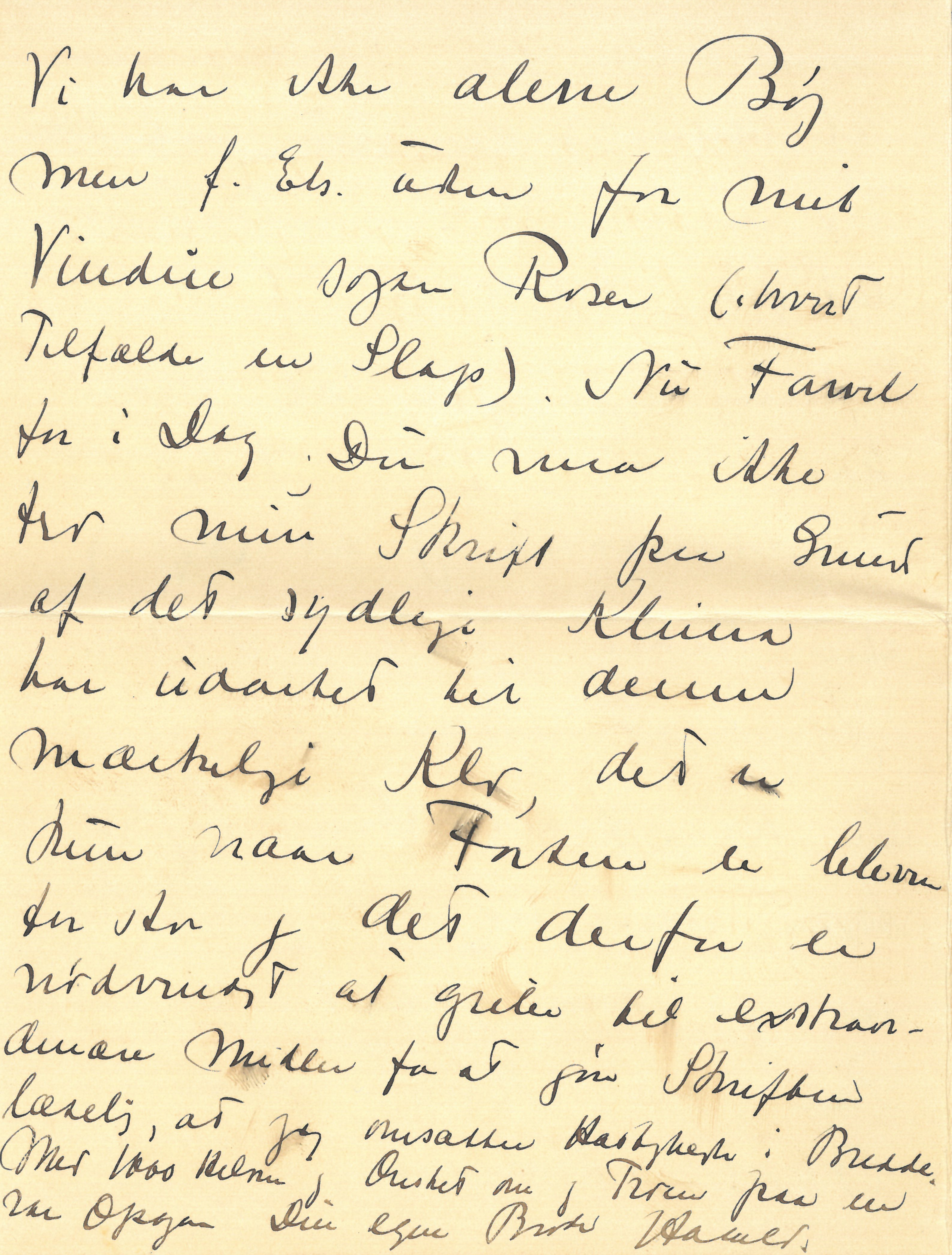
|Not only do we have beech, but under my window, e.g., also roses (at any rate a kind). Now goodbye for today. You must not think that the southern climate has altered my writing to this strange scrawl, it is only when my haste is too great and I am therefore forced to use extraordinary methods in order to make my writing legible that I convert my haste to broad text. With 1000 greetings and wishes and faith for a good assignment.